
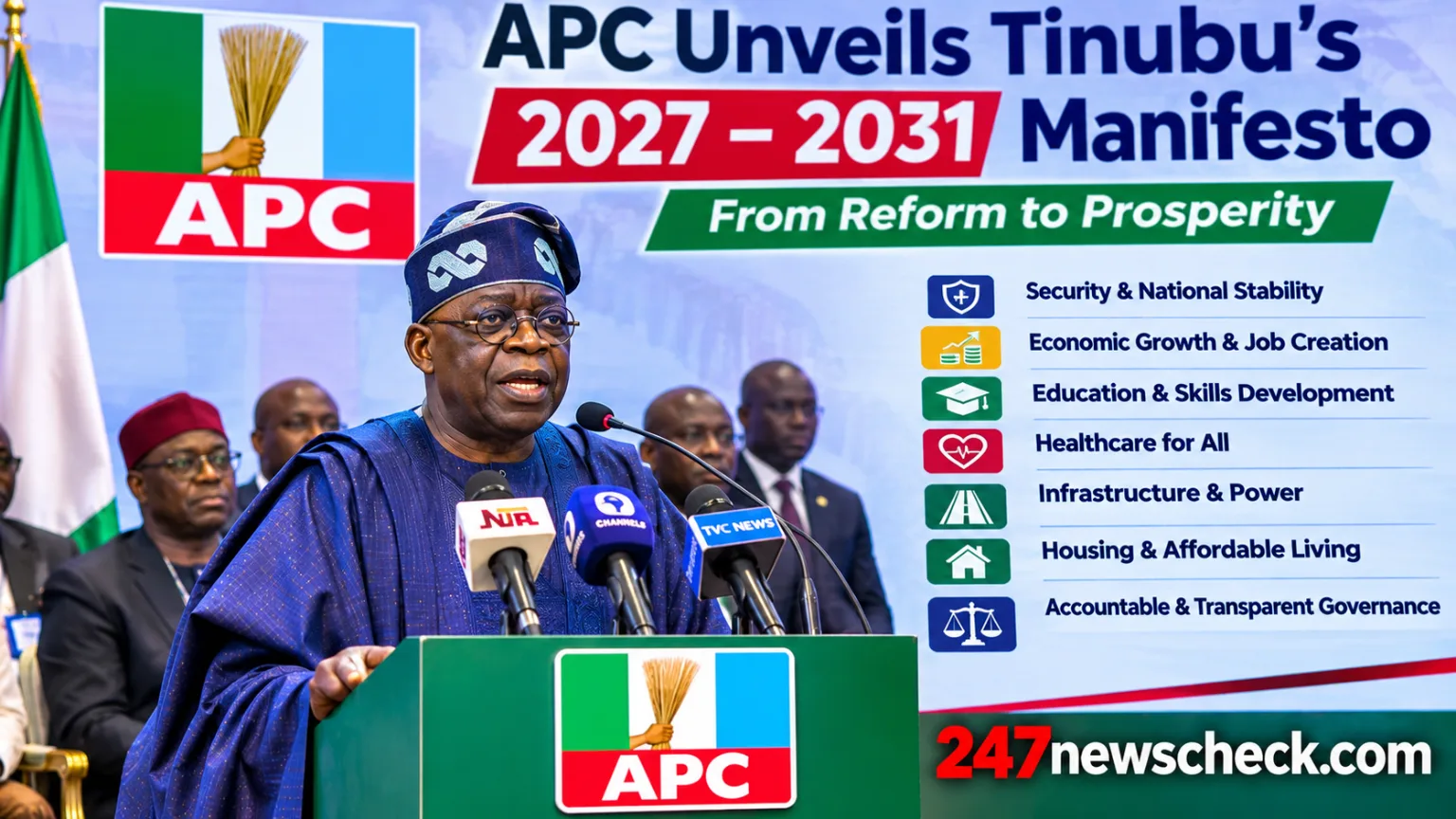
The ruling All Progressives Congress (APC) has unveiled its manifesto for the 2027 presidential election, outlining a proposed second-term agenda for President Bola Ahmed Tinubu built around national security, economic growth, improved living conditions and accountable governance.
The 109-page policy document, titled From Reform to Prosperity Agenda 2027–2031, was unveiled on Tuesday, November 10, 2026, at the Shehu Musa Yar'Adua Centre in Abuja.
The manifesto sets out the party's proposed priorities should Tinubu secure another four-year presidential mandate, with commitments covering security, infrastructure, electricity, education, healthcare, employment, housing and institutional reforms.
Among its headline economic targets are six per cent annual economic growth, increased non-oil export earnings of at least $15 billion and the creation of one million export-related jobs.
The party also outlined plans to recruit an additional 28,000 military personnel and 50,000 police officers as part of its proposed efforts to strengthen Nigeria's security architecture.
The manifesto represents the APC's policy proposals for the 2027–2031 period and should be distinguished from achievements already delivered by the administration.
Four Strategic Pillars of the APC Manifesto
The party organised its proposed second-term programme around four major pillars.
These are:
1. Secure and Resilient Nation.
2. Better Quality and More Affordable Life for Every Nigerian.
3. Energy, Infrastructure and Economic Growth.
4. Effective and Accountable Governance.
According to the APC, the framework is intended to build on the economic and institutional reforms introduced during Tinubu's first term while placing greater emphasis on translating policy changes into improvements in the daily lives of Nigerians.
The party also acknowledged the importance of addressing the cost of living, unemployment and other economic challenges facing households.
APC Outlines Plans to Recruit 78,000 Security Personnel
National security occupies a prominent position in the manifesto, with the APC proposing the recruitment of 28,000 additional military personnel and 50,000 police officers.
The party also pledged to complete and equip four new Army divisions located in Makurdi, Ilorin, Jalingo and Benin City.
Other proposed measures include strengthening intelligence-led military operations against insurgency, kidnapping and other organised criminal activities.
On policing, the manifesto proposes expanding recruitment towards a police-to-population ratio of one officer to 400 citizens.
It also outlines plans to introduce improved digital policing systems, body cameras, emergency communication channels and modern forensic facilities.
The party further indicated its intention to work with the National Assembly and state governments towards an accountable constitutional and legal framework for state and community policing.
These commitments come against the backdrop of continuing security challenges involving terrorism, banditry, kidnapping and communal violence in different parts of the country.
Economic Growth, Electricity and Industrial Development
Under its economic development pillar, the APC has set a target of achieving six per cent annual economic growth during the proposed second term.
The party also plans to expand electricity generation towards 10,000 megawatts, improve transmission and distribution infrastructure, increase electricity metering and extend clean energy access to underserved communities.
Industrial development also features prominently, with proposals to establish at least one major industrial hub in each of Nigeria's six geopolitical zones.
The manifesto further targets annual non-oil export earnings of at least $15 billion and one million export-related jobs.
It identifies manufacturing, agricultural processing, pharmaceuticals, digital services and other non-oil sectors as areas that could contribute to expanding Nigeria's economic base.
The party also promised to complete priority road, railway, port and airport projects to improve transportation efficiency and reduce the cost of moving goods across the country.
These targets, if implemented, would require sustained investment, effective project execution and coordination between federal and state authorities.
Education, Healthcare and Youth Employment
The APC's proposed social development programme includes commitments to improve access to education, strengthen healthcare delivery and expand opportunities for young Nigerians.
In education, the party pledged to recruit and train an additional 20,000 teachers while working towards halving the number of out-of-school children by 2031.
It also plans to expand technical and vocational education, improve digital learning opportunities and strengthen programmes connecting students with employment and entrepreneurship opportunities.
For healthcare, the manifesto proposes increasing active health insurance coverage to 40 per cent of Nigerians by 2031.
The party also aims to increase the proportion of functional primary healthcare centres nationwide towards 90 per cent and reduce out-of-pocket healthcare expenditure from approximately 71 per cent to below 50 per cent of total health expenditure.
On employment, the APC says it intends to halve youth unemployment by 2031 and provide skills training opportunities for two million young Nigerians.
Its digital development proposals also include expanding digital literacy programmes towards a target of 30 million Nigerians.
The manifesto further outlines plans to strengthen youth enterprise financing, support small businesses and improve opportunities for women entrepreneurs.
Housing and Cost-of-Living Commitments
The ruling party has also included housing and household affordability among its major proposed priorities.
Under the manifesto, it aims to facilitate the delivery of approximately 200,000 homes during the proposed second term through government housing programmes, mortgage financing and partnerships with private developers.
The party also proposes expanding affordable mortgage access, improving land administration and strengthening housing finance institutions.
On food affordability, the manifesto identifies agricultural production, storage facilities, transport infrastructure and food supply-chain improvements as important areas for intervention.
It also proposes strengthening social welfare programmes and expanding support for vulnerable households.
These commitments are particularly relevant given the financial pressures many Nigerian households continue to face.
Governance and Accountability
The fourth pillar focuses on institutional reforms, judicial administration, public-sector efficiency and accountability.
The APC says it intends to strengthen the justice system through electronic court processes, improved case management and measures aimed at reducing delays in the administration of justice.
The manifesto also proposes strengthening anti-corruption institutions, improving public asset management and expanding transparency in government spending.
Another proposed measure is to improve the implementation of financial autonomy for local governments while supporting further constitutional and fiscal reforms.
The party has also outlined a delivery framework under which major commitments are expected to have measurable targets, responsible institutions and reporting timelines.
It says public dashboards and independent verification should be used to monitor progress and enable citizens to assess implementation.
What the 2027–2031 Manifesto Means for Nigerians
The unveiling of the APC manifesto introduces a new set of policy commitments ahead of the 2027 general elections.
Its targets cover several areas directly connected to the concerns of Nigerian households and businesses, including insecurity, electricity supply, food prices, employment, housing and access to healthcare.
However, the publication of policy commitments does not automatically guarantee their implementation.
The proposed targets will ultimately be assessed against available funding, institutional capacity, implementation timelines and measurable improvements in the lives of Nigerians.
The document therefore provides an opportunity for voters, civil society organisations, policy analysts and other stakeholders to examine the party's proposed priorities and assess how they compare with its existing record in government.
As political activities ahead of the 2027 elections continue, the manifesto is expected to form an important part of the APC's campaign messaging and its presentation of a proposed second term under President Tinubu.
247NewsCheck.com will continue to monitor developments surrounding the 2027 general elections, political party manifestos and policy commitments as further verified information becomes available.