
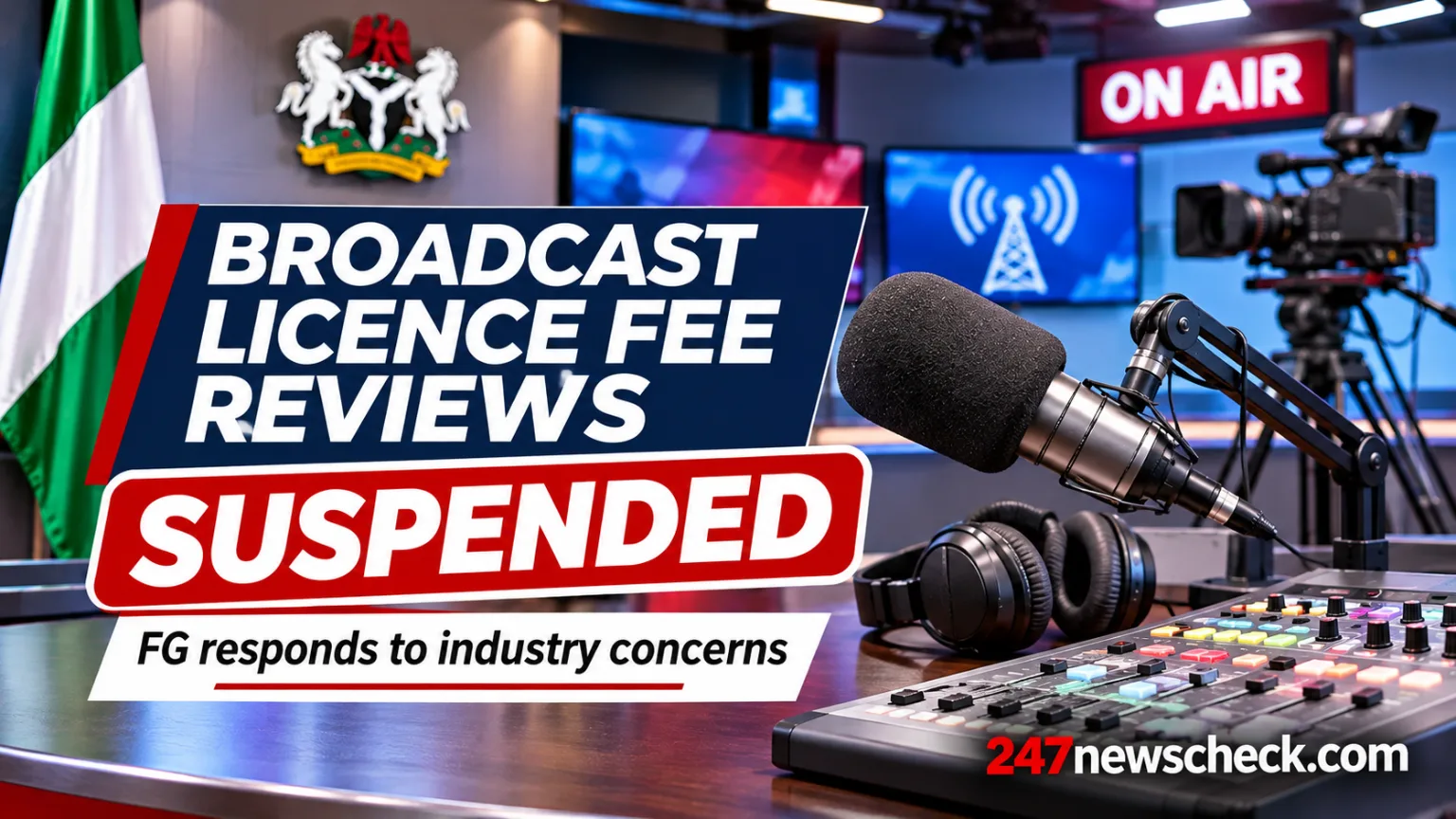
The Federal Government has suspended all reviews of broadcast licence fees until further notice, responding to concerns from television and radio operators over rising operational costs and mounting financial pressures across Nigeria's broadcasting industry.
The Minister of Information and National Orientation, Mohammed Idris, announced the decision on Monday, November 9, during a meeting with representatives of the Broadcasting Organisations of Nigeria (BON), led by its chairman, Senior High Chief Dr Tony Akiotu, in Abuja.
Following the meeting, Idris directed the National Broadcasting Commission (NBC) to ensure strict compliance with the suspension, confirming that proposed increases and other licence-related reviews would remain on hold while the government considers the industry's concerns.
The announcement represents an important intervention for broadcasting organisations operating in an increasingly demanding business environment, where electricity, fuel, equipment maintenance, transmission infrastructure and staffing expenses continue to place pressure on operational budgets.
However, the suspension does not cancel existing licence obligations or amount to a permanent reduction in regulatory charges. Rather, it places further reviews on hold until the government announces a subsequent decision.
Government Responds to Broadcasters' Financial Concerns
The intervention followed representations by BON concerning the economic and regulatory difficulties confronting broadcasting organisations across Nigeria.
During the meeting, the association identified several challenges affecting its members, including broadcast licence fees, rising operating expenses, access to affordable financing, spectrum allocation and the implementation of the 45-day advertising payment arrangement.
The association also raised concerns about the review of the National Broadcasting Code, which establishes important standards and regulatory requirements for licensed broadcasting organisations.
Responding to the concerns, Idris reaffirmed the Federal Government's commitment to creating a more supportive environment for the growth and sustainability of the broadcasting industry.
He subsequently directed the NBC to suspend all licence-related reviews until further notice.
The decision addresses a disagreement that has been developing for several years.
In July 2023, the then Director-General of the NBC, Balarabe Ilelah, disclosed that the commission was considering an upward review of licence charges for television and radio stations. The proposal attracted opposition from BON, which argued that higher charges could worsen the financial difficulties already confronting broadcasters.
In August 2023, Ilelah defended the existing charges, stating that the commission had not reviewed its licence fees for more than 20 years.
The latest suspension therefore represents a significant development in the relationship between broadcasting operators and the regulatory authorities.
NBC Directed to Accelerate National Broadcasting Code Review
Beyond the suspension of licence-fee reviews, the minister directed the NBC Director-General to accelerate the review of the National Broadcasting Code.
The code provides the regulatory framework governing broadcasting activities in Nigeria. It establishes standards covering professional conduct, programme content, compliance obligations and the responsibilities of licensed operators.
A review of the framework is intended to ensure that broadcasting regulations remain responsive to technological developments and changing industry realities.
For television and radio organisations, changes to the code could have implications for compliance procedures, operational responsibilities and the cost of meeting regulatory requirements.
However, the ministry has not announced a specific completion date for the review.
Meaningful engagement between regulators and industry stakeholders will therefore remain important in ensuring that any proposed changes consider both public-interest responsibilities and the practical realities of operating broadcasting businesses.
Government Moves to Enforce 45-Day Advertising Payment Period
Another significant issue discussed during the meeting was the implementation of the 45-day payment period for advertising services.
Idris disclosed that he had directed the Advertising Regulatory Council of Nigeria (ARCON) to ensure full implementation of the policy, following BON's request for stronger enforcement.
The issue is important because advertising remains a major source of income for many privately owned television and radio stations.
Broadcasters depend on advertising revenue to finance newsroom operations, content production, equipment maintenance, transmission services and staff salaries.
When payments are delayed beyond agreed periods, media organisations can experience cash-flow difficulties that affect their ability to meet routine financial obligations.
Smaller regional broadcasters may be particularly exposed because they often have fewer financial resources to absorb prolonged payment delays.
Effective implementation of the 45-day arrangement could improve payment predictability and strengthen commercial relationships between advertisers, advertising agencies and media organisations.
Nevertheless, the practical benefits will depend on consistent enforcement and compliance across the advertising industry.
Digital Switch-Over and Spectrum Allocation Remain Important Challenges
The meeting also addressed outstanding issues surrounding Nigeria's Digital Switch-Over (DSO) programme.
The transition is intended to move television broadcasting from analogue transmission to digital technology, creating opportunities for improved transmission efficiency and changes in the distribution of broadcasting services.
Idris promised to convene a stakeholders' meeting to address unresolved matters relating to the programme.
BON had previously acknowledged the minister's intervention during the June 2026 DSO launch, noting that consultations had helped address disagreements among industry participants.
However, questions concerning spectrum allocation and access to affordable financing remain important to the industry's development.
Spectrum availability is particularly significant because broadcasters require appropriate frequencies to transmit their services. Changes in spectrum allocation can therefore affect the operating environment for television and radio organisations.
The minister assured the association that the government would continue engaging relevant stakeholders on these matters.
What the Licence-Fee Suspension Means for Broadcasting Businesses
The suspension could provide some immediate financial and administrative relief for broadcasters by removing the uncertainty surrounding proposed licence-fee increases.
For media organisations preparing annual budgets, a pause in regulatory fee reviews may make it easier to plan expenditure without having to account for an anticipated increase in licence charges.
Smaller independent stations could particularly welcome the decision because they often operate with tighter budgets and limited access to external financing.
However, the suspension alone cannot resolve the wider economic pressures affecting the industry.
Electricity and fuel expenses, foreign exchange movements, imported broadcasting equipment, infrastructure maintenance and staff costs remain important considerations for media businesses.
The longer-term impact will depend on whether the government follows the announcement with practical measures addressing these structural challenges.
It will also be important for the NBC to communicate clearly how the suspension will be implemented and whether any further regulatory decisions will affect existing licence arrangements.
Broadcasters Urged to Uphold Professional Standards Ahead of 2027 Elections
As political activities increase ahead of Nigeria's 2027 general elections, Idris urged broadcasting organisations to maintain professionalism, fairness and responsible journalism.
He emphasised that freedom of expression must be accompanied by responsibility and adherence to established journalistic standards.
The minister's message reflects the important role television and radio stations play in informing citizens, providing platforms for public debate and supporting democratic participation.
Broadcasting organisations will face significant responsibilities during the election period, particularly in ensuring that political coverage is accurate, balanced and based on verifiable information.
BON, meanwhile, reiterated its preference for dialogue, consultation and mediation in resolving disagreements affecting the industry.
The association expressed appreciation for the minister's intervention and appealed for continued government engagement on the challenges confronting its members.
Outstanding Issues Will Determine the Impact of Government Intervention
Although the suspension of broadcast licence-fee reviews represents an important response to industry concerns, several matters remain unresolved.
These include the completion of the National Broadcasting Code review, outstanding Digital Switch-Over issues, spectrum allocation, access to affordable financing and the effective implementation of the 45-day advertising payment arrangement.
For broadcasters, the priority will be to determine whether the government's intervention translates into measurable improvements in their operating environment.
For regulators, the challenge will be to balance legitimate regulatory responsibilities with the financial sustainability of broadcasting organisations.
A stable and economically viable broadcasting sector is important not only to media businesses but also to public access to information, media diversity and democratic accountability.
247NewsCheck.com will continue to monitor the implementation of the Federal Government's broadcast licence-fee suspension, the enforcement of the 45-day advertising payment arrangement and further regulatory developments affecting Nigeria's broadcasting industry.