
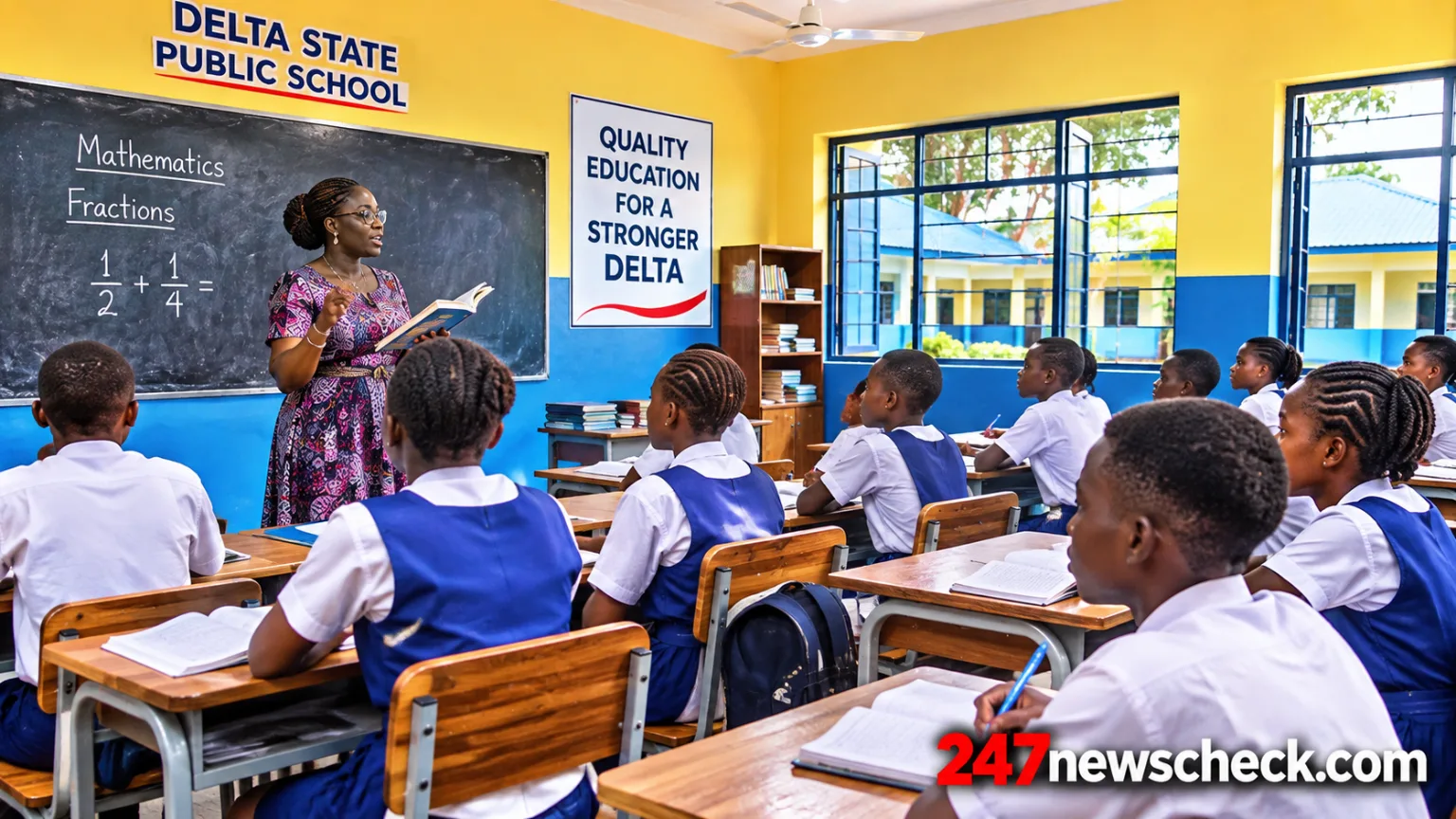
The Delta State Government has approved ₦10 billion for the construction, emergency reconstruction, and complete furnishing of classrooms across 92 public primary and secondary schools spanning the state's 25 local government areas.
The heavy capital injection was ratified during the State Executive Council meeting held on Monday, November 9, 2026, at the Government House Annex in Edjeba, Warri, under the chairmanship of Governor Sheriff Oborevwori.
Briefing journalists post-council, the Commissioner for Works (Rural Roads) and Public Information, Charles Aniagwu—who was accompanied by the Chief Press Secretary, Sir Festus Ahon—confirmed that the intervention is aimed at addressing chronic infrastructure deficiencies in public education corridors.
Rebuilding Learning Environments in Selected Institutions
According to the commissioner, the approved ₦10 billion project parameters will fund Phase One of a broader, systematically scheduled school infrastructure rehabilitation matrix.
"The government recognizes that access to quality education is inextricably linked to the physical condition of classroom environments," Aniagwu stated. He added that the Oborevwori administration is prioritizing equitable development across Delta's three senatorial districts, targeting structural deficits irrespective of a school's geographic location.
The initiative comes amid public scrutiny over state education budgets. External financial tracking data for the first half of 2026 revealed that despite Delta receiving ₦331.43 billion in net FAAC allocations, multiple rural and urban public schools continued to face blown-off roofs, cracked masonry, and general facility decay.
Over 4,500 School Furniture Units Apportioned
To directly combat the systemic challenge of students learning on bare floors, the State Executive Council additionally approved the production and phased distribution of more than 4,500 units of wooden school furniture.
The state government has engaged Setal Consolidated Enterprises to manufacture the wooden chairs and desks to strict technical specifications. Aniagwu clarified that the distribution of these items would be managed strictly through an empirical needs assessment compiled by the Ministries of Primary and Secondary Education.
"Distribution arrays will be based on localized enrollment data and existing functional seats rather than flat community quotas," the commissioner emphasized. "A school with 700 pupils may receive a smaller allocation than one with 400 pupils if the former already possesses standard learning desks. The core objective is bridging gaps equitably."
Strict Stakeholder Oversight Framework
To prevent contract abandonment and ensure project transparency, the executive council directed the line ministries to work directly with community representatives, parents, and local government area administrators.
Local education committees will be integrated into the direct monitoring loop, allowing stakeholders on the ground to track contractor execution and report structural shortcuts before final sign-offs are granted.
However, civil society networks note that while the ₦10 billion allocation marks a major legislative milestone, the state has yet to publish a comprehensive, school-by-school list detailing the exact names and individual contract values of the 92 beneficiary institutions. Transparency advocates argue that making these location-based metrics fully transparent is crucial to enabling real-time public tracking.
Comprehensive Infrastructure Rollout Approved
The education funding push was unveiled alongside several other key infrastructural approvals passed during the Monday executive council assembly. These complementary measures include:
• Legislative Expansion: Construction of additional residential quarters for state lawmakers to accommodate an increase in constituencies from 29 to 38.
• Healthcare Logistics: Development of 92 specialized residential quarters for medical personnel stationed at the Osubi Specialist Hospital.
• Road Reconstruction: Full reconstruction of the Uteh-Okpu to Umutu road corridor and internal road networks feeding the Warri Central Hospital.
• Civil Drainage: Funding to complete the lingering Asaba storm drainage project.
The state government also approved its proposed 2027 statutory budget profile, which is projected slightly above ₦1.2 trillion, as it seeks to structurally sustain its overarching 'MORE Agenda'.
247NewsCheck.com will continue to monitor the implementation of Delta State’s ₦10 billion school infrastructure project, tracking the release of the official beneficiary list and project completion timelines across the 25 LGAs.