
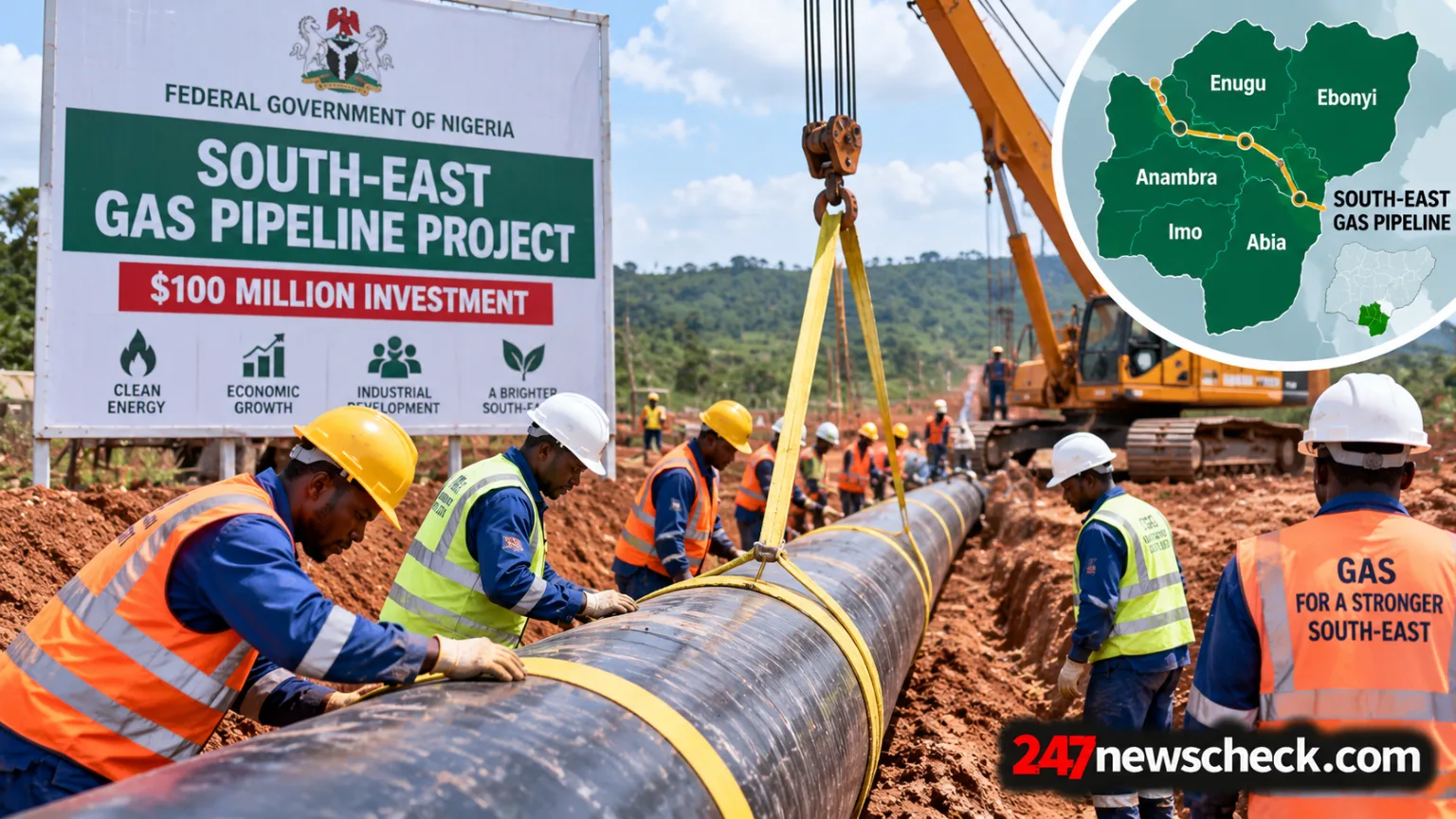
The Federal Government has launched a $100 million gas pipeline initiative designed to improve access to natural gas across Nigeria’s South-East, with the project expected to support manufacturing, attract investment and create employment opportunities across the region’s five states.
The investment agreement for the proposed South-East Gas Distribution Pipeline Project was signed on Tuesday, October 27, 2026, during an infrastructure investment and project development ceremony in Enugu. President Bola Tinubu was represented at the event by the Deputy Speaker of the House of Representatives, Benjamin Kalu.
The project is being advanced through the South-East Development Commission (SEDC) in partnership with private-sector participants, including GasSync Limited. It is intended to connect available gas resources to industrial and commercial customers in Abia, Anambra, Ebonyi, Enugu and Imo states.
Although the agreement marks a significant step towards implementation, construction is expected to begin in the first quarter of 2027, subject to funding, regulatory approvals and other project requirements.
Proposed 400-Kilometre Network to Serve Five States
The planned pipeline network is expected to extend approximately 400 kilometres across the South-East. Its proposed route begins in the Ohaji area of Imo State, with connections through Owerri and branches towards Aba in Abia State and Onitsha in Anambra State. Extensions are planned to serve Enugu and Ebonyi.
According to project details reported by Nigerian media, about 150 potential customers have been identified across manufacturing, power generation, agro-processing and other commercial activities. Their projected demand is estimated at approximately 254 million standard cubic feet of gas per day.
The proposed network is intended to reduce businesses’ dependence on road transportation of compressed natural gas and liquefied natural gas, which can add to energy supply costs and complicate deliveries to industrial facilities.
If successfully delivered, a more dependable gas distribution system could help businesses plan production more efficiently and improve access to energy for facilities that currently face supply constraints.
SEDC Commits Initial $3 Million
The South-East Development Commission has committed an initial $3 million towards the project and is seeking additional participation from regional governments, institutions and private investors.
SEDC Managing Director and Chief Executive Officer Mark Okoye said the commission had undertaken technical, financial and legal due diligence before its governing board approved the commitment.
The commission is targeting aggregate regional investment participation of up to $30 million, including its initial contribution, as part of a wider effort to mobilise the capital required for the project.
The initial commitment, however, should not be confused with full financing of the proposed $100 million first phase. Additional funding will be needed, and the final financing arrangements remain an important factor in determining the pace of implementation.
The partnership model is intended to combine public-sector coordination with private investment, reducing reliance on government budgets alone to finance infrastructure development.
Potential Benefits for Manufacturers and Businesses
The project is expected to support industrial activity in several established commercial centres across the South-East.
In Aba, Abia State, more reliable gas access could benefit manufacturing and power-related operations. In Onitsha and Nnewi, Anambra State, the network could support industrial clusters and businesses that depend on consistent energy supplies.
Enugu could benefit from renewed industrial investment, while improved energy access may create opportunities for agro-processing and other productive enterprises in Ebonyi State. In Imo, the project is intended to connect local gas resources to a wider regional market.
Project promoter GasSync has also identified potential customers in manufacturing, power generation and agriculture, with discussions reportedly under way with prospective industrial users, including Geometric Power in Abia State.
Nevertheless, these are expected benefits rather than guaranteed outcomes. Their realisation will depend on the completion of the pipeline, the availability of gas, commercially viable supply arrangements and businesses’ ability to connect to the network.
Construction Timeline and Implementation Challenges
Project representatives have indicated that construction is planned to begin in the first quarter of 2027, with first gas delivery targeted for the second quarter of 2028.
The schedule remains dependent on several conditions, including completion of financing arrangements, regulatory approvals, right-of-way access, environmental requirements and engagement with communities along the proposed route.
The project team has indicated that work could commence at Ohaji in Imo State and Onitsha in Anambra State simultaneously to accelerate delivery and allow different sections of the network to progress in parallel.
State governments and host communities are expected to play important roles in facilitating access, securing necessary approvals and maintaining cooperation throughout implementation.
Meeting the proposed timetable will require effective coordination among the Federal Government, the SEDC, project partners, regulators, investors and the five state governments.
A Test of the South-East’s Industrial Ambitions
The gas pipeline initiative forms part of wider efforts to strengthen the South-East’s economic integration and expand its industrial capacity. The region has a substantial base of commercial activity, manufacturing businesses and entrepreneurs, but access to reliable and affordable energy remains a challenge for many enterprises.
A functioning regional gas network could help address part of that challenge by linking gas supply to industrial demand across state boundaries. It could also improve the region’s attractiveness to investors considering new factories, processing facilities and other energy-intensive businesses.
However, the project’s success will ultimately be judged by more than the signing of an investment agreement. Key measures will include whether financing is secured, construction begins on schedule, gas deliveries commence as planned, industries gain access to supply and the expected employment and investment benefits materialise.
For now, the agreement represents an important development in the South-East’s infrastructure plans, while the next phase will require sustained financing, transparent project management and measurable implementation progress.
247NewsCheck.com will continue to monitor developments in the South-East gas pipeline project, including financing, construction milestones and the timeline for first gas delivery, as further verified information becomes available.