
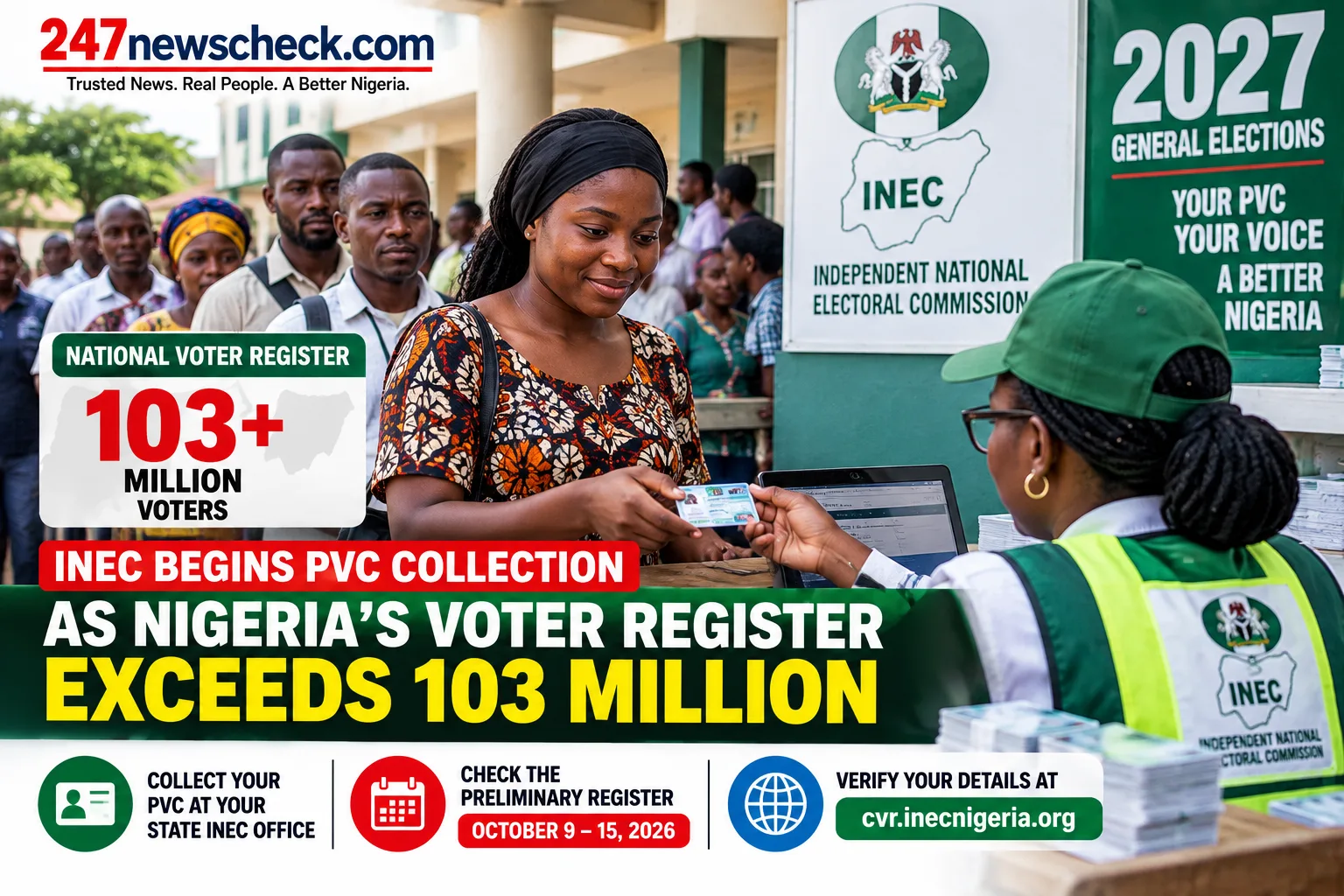
The Independent National Electoral Commission (INEC) has commenced nationwide distribution of Permanent Voter Cards (PVCs) as preparations intensify for Nigeria’s 2027 general elections.
The exercise, which began on Friday, October 9, 2026, comes as the commission reports that Nigeria’s national register of voters has grown to more than 103 million following the completion of its three-phase Continuous Voter Registration exercise.
For millions of Nigerians who have registered to vote, the announcement is an important reminder that participating in an election involves more than completing registration. Eligible voters also need to confirm their registration details, collect available cards and follow official instructions before election day.
INEC has also scheduled the display of the preliminary register of voters from October 9 to October 15, giving registered voters an opportunity to examine their information and raise claims or objections where necessary.
The development marks another stage in preparations for the 2027 elections, when voters will choose leaders at the federal and state levels.
National Voter Register Crosses 103 Million
INEC Chairman, Professor Joash Amupitan, disclosed that the national register had surpassed 103 million voters following the conclusion of the three-phase Continuous Voter Registration exercise.
According to the commission, the registration process attracted 10,772,421 new voters.
The newly registered voters underwent biometric verification, while INEC completed a final Automated Biometric Identification System review intended to identify and remove duplicate records.
The growing register reflects the number of people recorded as registered voters. However, the figure should not be interpreted as a guarantee that every registered person has collected a PVC or will participate in the election.
Voter registration, card collection and actual turnout are separate stages of the electoral process.
The challenge now is to ensure that eligible voters can access their cards, confirm that their details are correct and obtain reliable information about the arrangements applicable in their locations.
When Does PVC Collection Take Place?
INEC announced that nationwide PVC collection would commence on October 9, 2026.
The commission has also scheduled a seven-day display of the preliminary register of voters, running from October 9 to October 15.
During this period, voters are encouraged to check the information recorded against their registration, including their names, photographs, dates of birth and polling-unit details.
The exercise is particularly important for people who recently registered and those who need to confirm that their details have been correctly captured.
Collection procedures and locations can vary according to the state, local government area and type of card involved. Registered voters should therefore confirm the latest instructions from their relevant INEC office before travelling.
The commission has indicated that some categories of cards, including those relating to later registration phases, transfers, updates and replacement requests, may have separate availability arrangements. Voters should not assume that every requested card will be ready for collection at the same time.
How to Check Your PVC Collection Arrangements
Registered voters can use INEC’s official Continuous Voter Registration portal to check their PVC status and identify the appropriate collection arrangements.
The portal is available at:
Voters should follow these steps:
Step 1: Open the official INEC portal.
Visit the commission’s CVR portal directly rather than relying on unofficial websites, social media posts or messages from unknown individuals.
Step 2: Select the PVC status or collection option.
Follow the available instructions to check whether your card is ready and identify the collection centre associated with your registration.
Step 3: Confirm the collection location.
Check the address and any instructions provided. Where the information is unclear, contact the relevant INEC state or local government office before making the journey.
Step 4: Follow the identification and collection instructions.
Take the information or documents requested by INEC. If your card is unavailable, ask officials for the correct next step rather than making repeated trips based on unverified information.
Step 5: Keep your card safe after collection.
Check that the card belongs to you and store it securely. If it is lost, damaged or contains an error, contact INEC for guidance on the applicable procedure.
The official portal also provides information about uncollected PVCs, registration centres, transfers and replacement requests.
Voters should be cautious of anyone demanding unofficial payments or promising to speed up collection through personal connections. Use INEC’s official channels to verify requirements and report suspicious requests.
Why Voters Should Check Their Registration Details
PVC collection is not the only reason to pay attention to the current exercise. Checking the preliminary register is also an opportunity to identify errors before the election.
A voter may discover that a name has been misspelled, a date of birth has been recorded incorrectly or other registration details do not match the information supplied during registration.
The display exercise allows registered voters to raise claims or objections through the procedures provided by INEC.
Checking these details early can help voters identify problems while there is still an opportunity to seek clarification or correction.
Voters should pay particular attention to their names, photographs and polling-unit information. If anything appears incorrect, they should ask the appropriate INEC officials how to submit a claim or objection within the prescribed period.
The public should also avoid sharing sensitive personal information or photographs of their voter cards on social media. Registration details should be handled carefully to reduce the risk of impersonation, fraud or misuse.
Why PVC Collection Matters Ahead of the 2027 Elections
The PVC remains an important part of Nigeria’s established voting process. It is used alongside INEC’s voter accreditation procedures, including the Bimodal Voter Accreditation System (BVAS).
Collecting the card early gives voters more time to resolve questions about its availability or the information recorded on it.
It also reduces the risk of leaving collection until the final stages of election preparations, when large numbers of people may be seeking assistance at the same time.
For first-time voters, completing the process can be an important step in preparing to participate in public decision-making.
For voters who have participated in previous elections, checking their current registration details is equally important. They should not assume that an old card or previous registration automatically resolves every issue concerning a recent transfer, replacement request or other update.
INEC remains the appropriate authority for confirming an individual’s registration and explaining the procedures applicable to a particular case.
What the 103 Million Voter Figure Means for Nigeria
A national voter register exceeding 103 million represents a substantial pool of registered voters ahead of the next general election.
However, the size of the register is only one measure of electoral preparedness. The quality of the register, the accessibility of voting arrangements, the conduct of election officials and public confidence in the process also matter.
A credible electoral process depends on eligible voters being properly registered, records being accurate and procedures being applied consistently.
It also requires voters to have access to timely and reliable information. Confusing or contradictory instructions about PVC collection can discourage participation, particularly among people who must travel long distances or take time away from work to visit an INEC office.
INEC has urged media organisations to help communicate accurate information as the 2027 election cycle progresses. This makes responsible reporting and the verification of official announcements particularly important.
For voters, the practical priority is to confirm their own registration and collection arrangements rather than relying solely on the national total.
The Role of PVC Collection in Electoral Credibility
Election credibility involves more than the number of people who register. Voters also need confidence that their records are accurate, the rules are clear and the process is administered fairly.
INEC has said it is working to improve election technology, including BVAS and the INEC Result Viewing Portal, commonly known as IReV.
These systems are intended to support aspects of voter accreditation and public access to election results. Their effectiveness will depend on proper deployment, technical readiness, clear procedures and timely communication when problems arise.
PVC collection is therefore one part of a wider preparation process that includes voter education, logistics, staff readiness, security coordination and the management of election materials.
As the 2027 elections approach, the public will be watching how INEC handles these responsibilities and responds to concerns raised by voters and other stakeholders.
What Voters Should Do Before October 15
With the preliminary register display scheduled to end on October 15, registered voters should use the available period to check their details and follow the instructions provided by their local INEC office.
Anyone who has not collected an available PVC should confirm the collection point and opening arrangements before travelling.
Those who notice incorrect information should ask about the formal claims or objections procedure and the applicable deadline.
Voters whose cards are not yet available should seek official guidance on when and where collection will take place. They should not assume that a missing card means their registration has been cancelled.
People who have lost or damaged their cards, requested a transfer or updated their details should confirm the status of the specific request, as these categories may follow different arrangements.
Where official information is unclear, voters can contact INEC through its published communication channels or consult the commission’s website at https://www.inecnigeria.org/.
The most important step is to rely on confirmed information and complete the relevant procedures within the official timelines.
Conclusion: Early Preparation Can Help Voters Avoid Last-Minute Problems
INEC’s commencement of PVC collection marks an important stage in preparations for Nigeria’s 2027 general elections, with the national voter register now exceeding 103 million.
The current exercise gives registered voters an opportunity to collect available cards, verify their information and raise concerns about errors in the preliminary register.
For voters, early action can help prevent avoidable difficulties as election day approaches. For INEC, the challenge is to make the process accessible, communicate clearly and ensure that eligible voters receive accurate information about their cards and registration status.
The success of an election depends not only on the number of people on the register but also on the integrity of the process and the confidence citizens have in it.
As the seven-day display exercise continues, Nigerians are encouraged to check their details, confirm their collection arrangements and follow official updates.
247NewsCheck will continue to report verified developments on PVC collection, voter education and preparations for the 2027 general elections.