
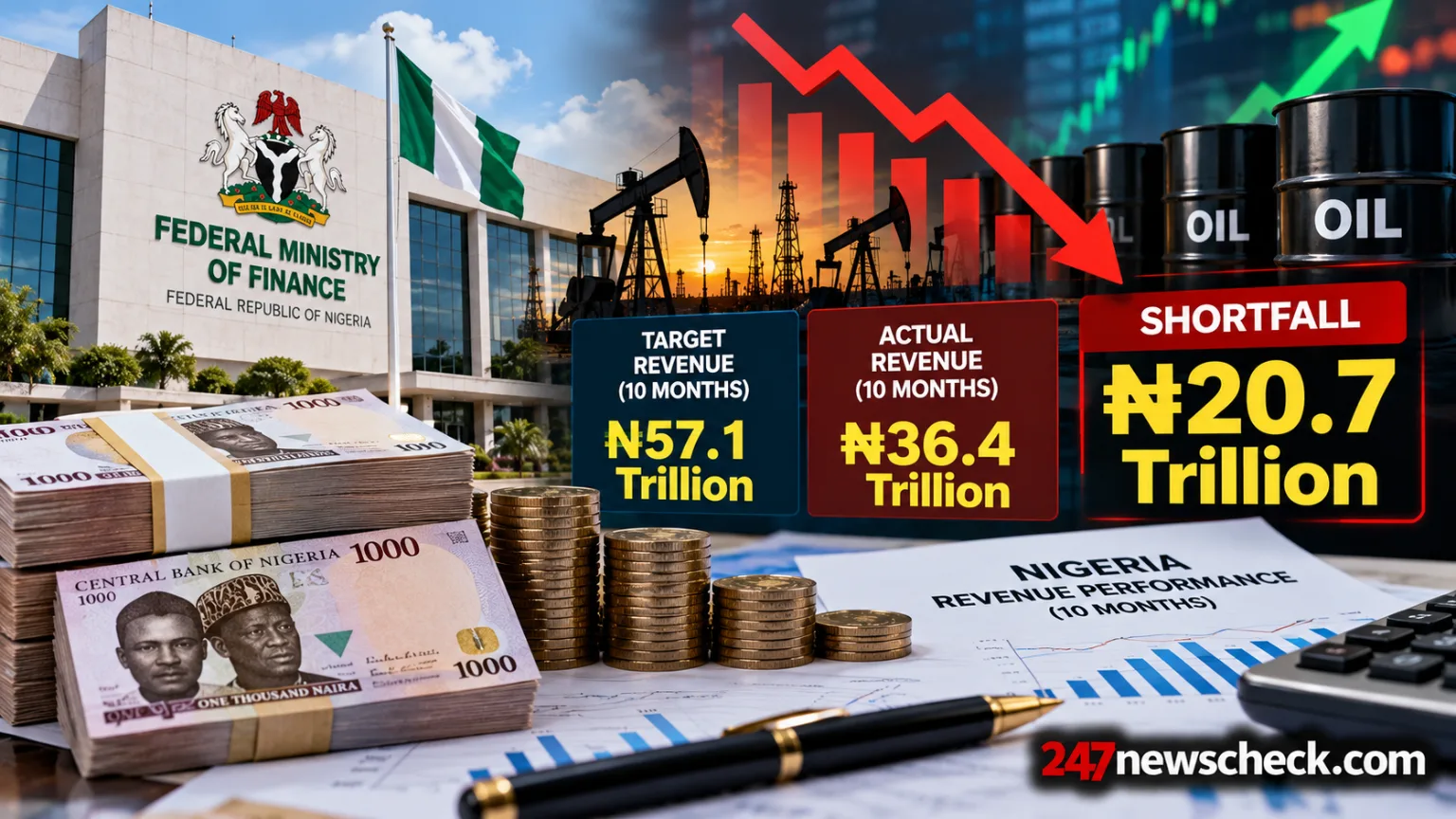
Nigeria’s statutory revenue collections fell ₦20.74 trillion short of the government’s target for the first 10 months of 2026, despite a substantial rise in international crude oil prices that raised expectations of stronger earnings for the oil-producing country.
Figures contained in the Federation Account income distribution report of the Office of the Accountant-General of the Federation show that statutory revenue stood at approximately ₦26.14 trillion between January and October, compared with a target of ₦46.87 trillion for the period.
The reported deficit represents about 44.24 per cent of the projected amount, underscoring the difficulty of translating favourable conditions in the international oil market into revenue sufficient to meet the government’s fiscal expectations.
The figures were reported by The Punch following an analysis of documents associated with the Federation Account Allocation Committee’s review of revenue accounts.
Revenue Collections Remain Below Budget
The reported data indicate that Nigeria fell short of its monthly statutory revenue benchmark throughout the 10-month period, although collections improved during some months.
Receipts began the year at approximately ₦1.63 trillion in January and rose to ₦1.96 trillion in February before declining to about ₦1.56 trillion in March.
Collections recovered gradually in the following months, reaching approximately ₦2.38 trillion in May and ₦2.65 trillion in June. Revenue then increased to about ₦3.95 trillion in July, including a reported ₦250 billion augmentation, before peaking at approximately ₦4.36 trillion in August.
August recorded the strongest monthly performance in the period reviewed, coming closer to the monthly target of approximately ₦4.69 trillion. However, collections fell sharply to about ₦2.85 trillion in September before recovering modestly to approximately ₦3.10 trillion in October.
The improvement in the later months was not sufficient to offset the shortfalls accumulated earlier in the year.
The figures also require careful interpretation: the reported statutory revenue total is a specific measure of Federation Account receipts and should not be confused with total government revenue across every tax, fee and other income source.
Higher Crude Prices Raise Questions About Revenue Performance
The shortfall emerged against a backdrop of sharply higher international oil prices. Nigeria’s Bonny Light crude grade was reported at approximately $123.97 per barrel on 22 October, significantly above the Federal Government’s 2026 budget benchmark of $64.85 per barrel. The rise in prices followed disruptions to global oil supplies linked to the conflict involving the United States, Israel and Iran.
For an oil-producing country such as Nigeria, stronger crude prices can improve export earnings and potentially increase government receipts. However, the relationship between market prices and public revenue is not automatic.
The amount ultimately received by government depends on several factors, including crude oil production volumes, export performance, the costs and deductions associated with petroleum operations, the timing of remittances, exchange-rate movements and the effectiveness of revenue collection.
Consequently, higher international prices do not, by themselves, establish how much additional money has accrued to the Federation Account.
The reported figures show that statutory revenue remained below its budget benchmark despite the favourable price environment. They do not prove that Nigeria received no benefit from higher prices, nor do they independently establish the precise contribution of oil production or other factors to the shortfall.
August Gains Followed by a September Decline
The monthly figures illustrate how uneven revenue performance was during the period.
Between January and June, statutory receipts totalled approximately ₦11.88 trillion. Collections from July to October amounted to about ₦14.26 trillion, according to the reported figures, including the July augmentation.
The four-month total was higher than the amount recorded in the preceding six months. Nevertheless, the September decline and the incomplete recovery in October meant the stronger performance did not close the overall gap against the budget.
This pattern highlights the difference between a temporary improvement in monthly receipts and sustained performance sufficient to meet a full-period revenue target.
It also reinforces the need to examine production, collection and remittance data alongside global oil prices when assessing the government’s fiscal position.
Implications for Government Funding
Revenue performance matters because the Federal Government, state governments and local government councils rely on funds distributed through the Federation Account to finance public responsibilities.
When collections fall below projections, governments may face additional pressure when planning infrastructure projects, funding public services and meeting other budget commitments. The precise consequences depend on the wider fiscal position, available financing, expenditure priorities and subsequent revenue performance.
A revenue shortfall does not automatically mean that all planned projects will be cancelled or that every tier of government will receive a specific reduction. Those outcomes would depend on actual allocations and the decisions taken by the relevant authorities.
However, a persistent gap between expected and realised receipts can make budget implementation more difficult and increase the importance of realistic revenue forecasts.
Nigeria’s fiscal outlook also depends on non-oil sources of income. Tax administration, compliance, broader economic activity and the government’s ability to collect revenues due can all influence the amount available to fund public expenditure.
The Challenge Beyond Oil Prices
The latest figures point to a wider fiscal challenge: favourable movements in commodity markets cannot guarantee that revenue targets will be achieved.
For Nigeria to benefit consistently from higher crude prices, stronger prices must be accompanied by adequate production, reliable exports, effective revenue collection and transparent accounting of the proceeds due to the Federation.
Improving the accuracy of budget assumptions and monitoring actual collections against projections may also help policymakers identify emerging gaps earlier and adjust spending plans accordingly.
The reported ₦20.74 trillion shortfall therefore raises important questions about the factors limiting statutory revenue performance during the first 10 months of 2026. A detailed breakdown of the contribution of oil receipts, production volumes, remittances and non-oil sources would be needed to determine the relative weight of those factors.
The figures provide a clear measure of the distance between the government’s revenue target and reported collections, but they are not, on their own, a complete explanation of the causes.
247NewsCheck.com will continue to monitor Nigeria’s revenue performance, Federation Account allocations and fiscal policy developments as further verified information becomes available.