Nigeria’s state governments have received a substantial increase in public revenue, creating more room to invest in roads, schools, hospitals and other essential services. However, a new World Bank report has raised questions about how these additional resources are being distributed, particularly as education accounts for a smaller share of total state spending.
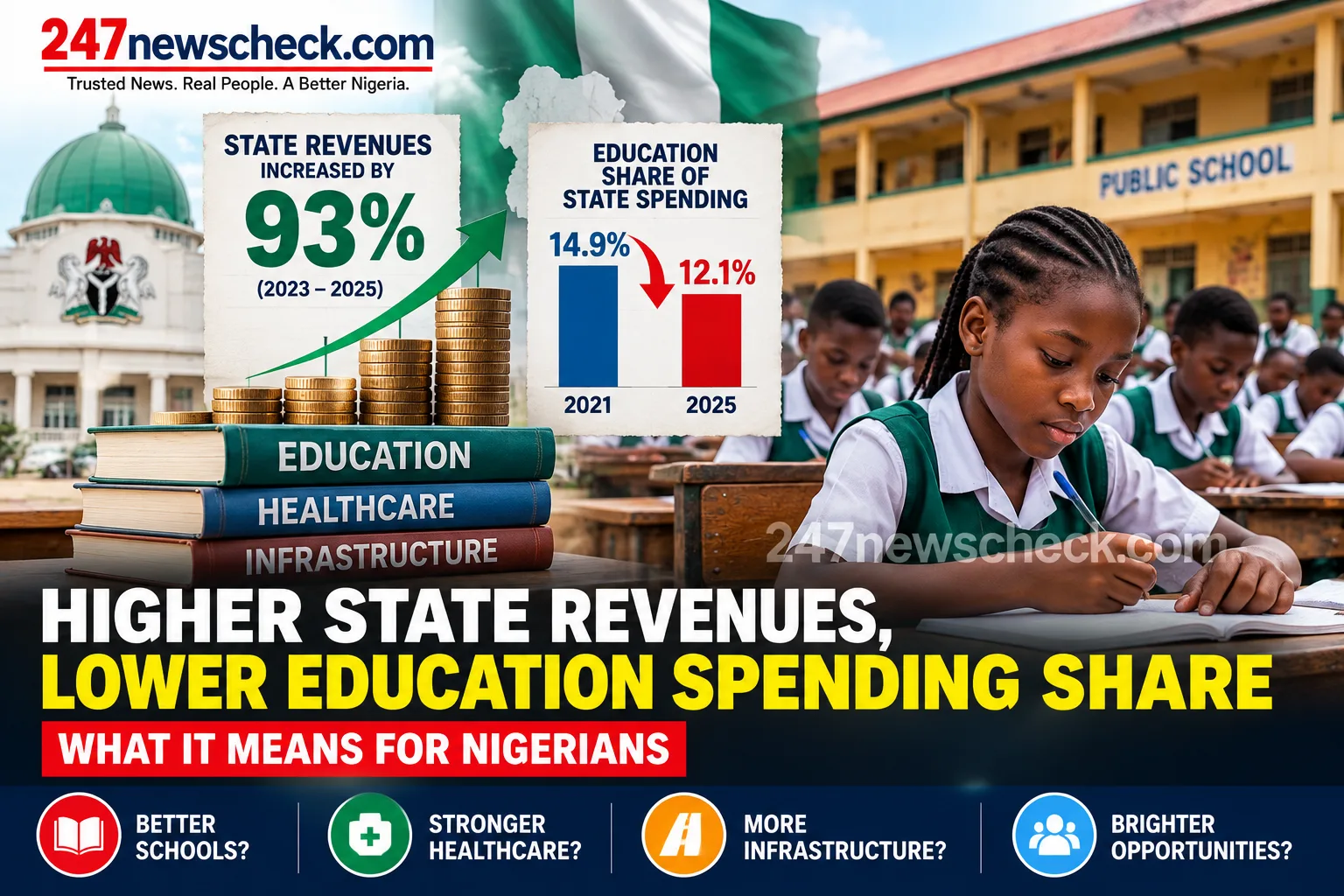
The World Bank’s latest Nigeria Development Update, released on October 8, 2026, found that aggregate state revenues increased by about 93 per cent in real terms between 2023 and 2025. State expenditure also rose by approximately 92 per cent over the same period.
Despite the growth in available resources, education’s share of total state expenditure declined from 14.9 per cent in 2021 to 12.1 per cent in 2025. Health spending remained broadly stable at around seven per cent, while social protection’s share increased from 1.4 per cent to 4.4 per cent.
The findings highlight a major question for public finance in Nigeria: as state governments receive more money, are their spending decisions producing the improvements in education, healthcare and living standards that residents expect?
For parents worried about classroom conditions, students facing limited learning resources and communities seeking better public services, the answer matters far beyond government budget figures.
How State Revenues Increased
The findings are contained in the World Bank’s Nigeria Development Update, titled Beyond the Federal Purse: How Higher Revenues Reshaped State Priorities.
The report examines how recent economic and fiscal changes have influenced the money available to state governments and the decisions they make about public spending.
Several factors contributed to the increase in revenue, including exchange-rate reforms, the removal of the petrol subsidy, stronger revenue administration and increased collections from the federation account.
States also benefited from refunds, the settlement of longstanding federal obligations, dedicated intervention funds and stronger Value Added Tax collections.
The combined effect was a substantial improvement in state finances. According to the World Bank, state revenues increased by approximately 93 per cent in real terms between 2023 and 2025, using 2019 prices to account for changes in the value of money.
This is an important distinction. The figure is not simply an increase caused by higher prices or inflation; it reflects growth after adjusting for changes in purchasing power.
However, greater revenue does not automatically translate into better services. The impact depends on how governments allocate funds, select projects, manage contracts and measure results.
Why Education’s Share of Spending Matters
Education’s share of total state expenditure fell from 14.9 per cent in 2021 to 12.1 per cent in 2025, according to the report.
That decline deserves attention because education is closely connected to Nigeria’s long-term economic prospects. Schools help develop the skills that employers need, prepare young people for further training and create opportunities for individuals to participate in the economy.
When public education systems lack adequate facilities, learning materials, trained teachers or reliable infrastructure, the consequences can extend beyond the classroom.
Students may struggle to acquire essential skills, parents may face additional expenses, and employers may find it more difficult to recruit workers with the capabilities they require.
A lower share of state expenditure devoted to education does not, by itself, prove that education budgets were cut. The World Bank says spending on education increased in absolute terms, but grew more slowly than spending on economic infrastructure.
In other words, education received a smaller proportion of the total spending envelope even as expenditure on the sector increased.
This distinction matters when assessing the figures fairly. The question is not only whether education budgets grew, but whether the growth was sufficient to address the needs of schools and learners.
Why States Are Spending More on Infrastructure
The World Bank found that state governments directed a larger share of their expenditure towards capital projects as their revenues increased.
Capital spending rose from 46 per cent of total state expenditure to 61 per cent over the period examined.
Transport infrastructure recorded the largest increase, alongside substantial increases in spending on housing, agriculture and other investments intended to support economic activity.
There are clear reasons governments invest in roads and other infrastructure. Better roads can reduce travel times, improve access to markets and make it easier to transport agricultural produce. Housing and other productive investments can also support jobs and economic growth when projects are properly selected and delivered.
For a farmer trying to move produce to market or a trader transporting goods between towns, improved infrastructure can make a practical difference.
However, infrastructure and human development should not be treated as competing priorities that must exclude one another. Roads, schools, hospitals and water systems all contribute to the quality of life and economic potential of a community.
The challenge for state governments is to balance long-term infrastructure investment with the public services people need every day.
What the Figures Mean for Parents and Students
For families, government spending priorities can influence the quality and availability of public education.
Adequate investment can support classroom maintenance, teaching materials, teacher development, sanitation and other facilities that help students learn. It can also improve access to education in communities where schools face resource shortages.
The World Bank’s figures do not establish that every state has reduced its education budget or that school conditions have worsened everywhere. State spending patterns differ, and a national aggregate can conceal significant differences between individual governments.
Nevertheless, the decline in education’s share of expenditure raises a reasonable question: are budget increases translating into improvements that students and parents can see?
To answer that question, residents need more than headline spending figures. They need accessible information about education allocations, actual releases, completed projects, teacher recruitment, school facilities and measurable learning outcomes.
A state may announce a large education budget, but the public also needs to know whether the money was released, how it was spent and what changed as a result.
Healthcare and Social Protection Also Matter
Education was not the only social sector examined in the report.
Health spending remained broadly stable at around seven per cent of total state expenditure. Meanwhile, the share allocated to social protection rose from 1.4 per cent in 2021 to 4.4 per cent in 2025.
Social protection programmes can include forms of support designed to help vulnerable households manage economic hardship. Their effectiveness depends on the design of the programmes, the identification of eligible beneficiaries and whether assistance reaches the people who need it.
For healthcare, reliable funding is important for maintaining facilities, supporting healthcare workers and improving access to essential services.
The figures suggest that states have made different choices as their financial resources have expanded. The broader task is to ensure that economic infrastructure, education, healthcare and social support work together to improve living conditions.
Higher Revenue Does Not Automatically Mean Better Living Standards
The increase in state revenue offers governments an opportunity, but it does not guarantee that residents will experience better services.
Public spending must be converted into results. A road project should improve access and mobility; a school investment should help create a better learning environment; and healthcare funding should strengthen the services available to patients.
That requires effective procurement, careful project selection, transparent accounts and proper monitoring.
The World Bank has stressed the importance of spending efficiency, accountability and improved service delivery. Its position is that the additional resources available to state governments should help improve infrastructure, education, healthcare and water services, which are essential to creating more and better jobs.
The report also notes progress in fiscal reporting, transparency and internally generated revenue among states. Further improvements in spending efficiency and revenue collection remain important next steps.
For residents, accountability should mean being able to see what government promised, what was funded, what was completed and whether the project delivered its intended benefit.
What State Governments Should Do Next
The report provides an opportunity for state governments to explain how they intend to use their improved financial positions.
First, governments should make budget information easier to access. Residents should be able to find out how much has been allocated to education, healthcare, infrastructure and social protection, as well as how much has actually been spent.
Second, states should publish clearer information about project delivery. Budget allocations are important, but they do not demonstrate that a project has been completed or that it is functioning properly.
Third, education spending should be assessed against actual needs and outcomes. This includes examining classroom conditions, teacher availability, learning resources and access to schools, rather than focusing only on the percentage of a budget assigned to the sector.
Fourth, governments should strengthen independent oversight and public reporting so that residents, journalists and civil society groups can assess how public funds are used.
Finally, spending plans should balance economic infrastructure with investment in people. Roads and other productive assets can support growth, but a stronger workforce also requires access to good education, healthcare, clean water and opportunities to develop skills.
What Nigerians Should Watch in Their States
The World Bank’s findings offer a starting point for citizens who want to understand their state government’s priorities.
Residents can examine their state’s approved budget and budget performance reports, where available, and compare planned spending with actual expenditure.
Parents can follow announcements about school renovations, teacher recruitment and education programmes, then look for evidence that projects have been completed.
Communities can monitor the delivery of public infrastructure and ask whether promised facilities are operating as intended.
Journalists and civil society organisations can also use published budget information to compare allocations, spending and outcomes across different sectors.
These checks are especially useful because national figures do not tell the full story of each state. Some governments may have invested more effectively in education than others, while some may face different revenue pressures or service-delivery challenges.
The goal should be to understand what is happening locally and assess performance using evidence rather than assumptions.
The Wider Economic Picture
The report comes as Nigeria’s economy shows signs of improved growth, although many households continue to face pressure from the cost of living.
The World Bank reported that real gross domestic product grew by 4.2 per cent in the first half of 2026, compared with 3.9 per cent in the corresponding period of 2025 and 3.5 per cent in the first half of 2024.
The bank said services contributed significantly to growth, alongside a stronger contribution from agriculture. It also reported that higher oil prices supported export earnings and public revenues, although higher fuel costs and seasonal food-price pressures slowed progress in reducing inflation.
The World Bank projects average economic growth of 4.4 per cent between 2026 and 2028, while inflation is expected to decline gradually to around 12 per cent by 2028.
These projections depend on continued reforms and other economic conditions. They do not remove the need for governments to ensure that growth translates into better services and opportunities for ordinary Nigerians.
Economic growth can create additional resources, but public policy and spending decisions help determine how widely the benefits are shared.
Conclusion: The Real Test Is What Nigerians Receive in Return
The 93 per cent increase in state revenues between 2023 and 2025 gives Nigeria’s state governments greater fiscal space to address longstanding development needs.
The World Bank’s findings also show that spending priorities have shifted towards economic infrastructure, while education has taken a smaller share of total state expenditure.
That does not mean education spending fell in absolute terms. It means education spending grew more slowly than overall expenditure, leaving it with a smaller proportion of the total.
For Nigerians, the most important question is whether the additional public resources are producing visible improvements in schools, healthcare, infrastructure, water services and household wellbeing.
State governments now have an opportunity to demonstrate that higher revenue can deliver more than larger budgets and ambitious project announcements.
The measure of success will be better services, stronger opportunities for young people and more accountable use of public money.
247NewsCheck will continue to follow state budgets, public spending and the impact of government decisions on education and other essential services across Nigeria.