
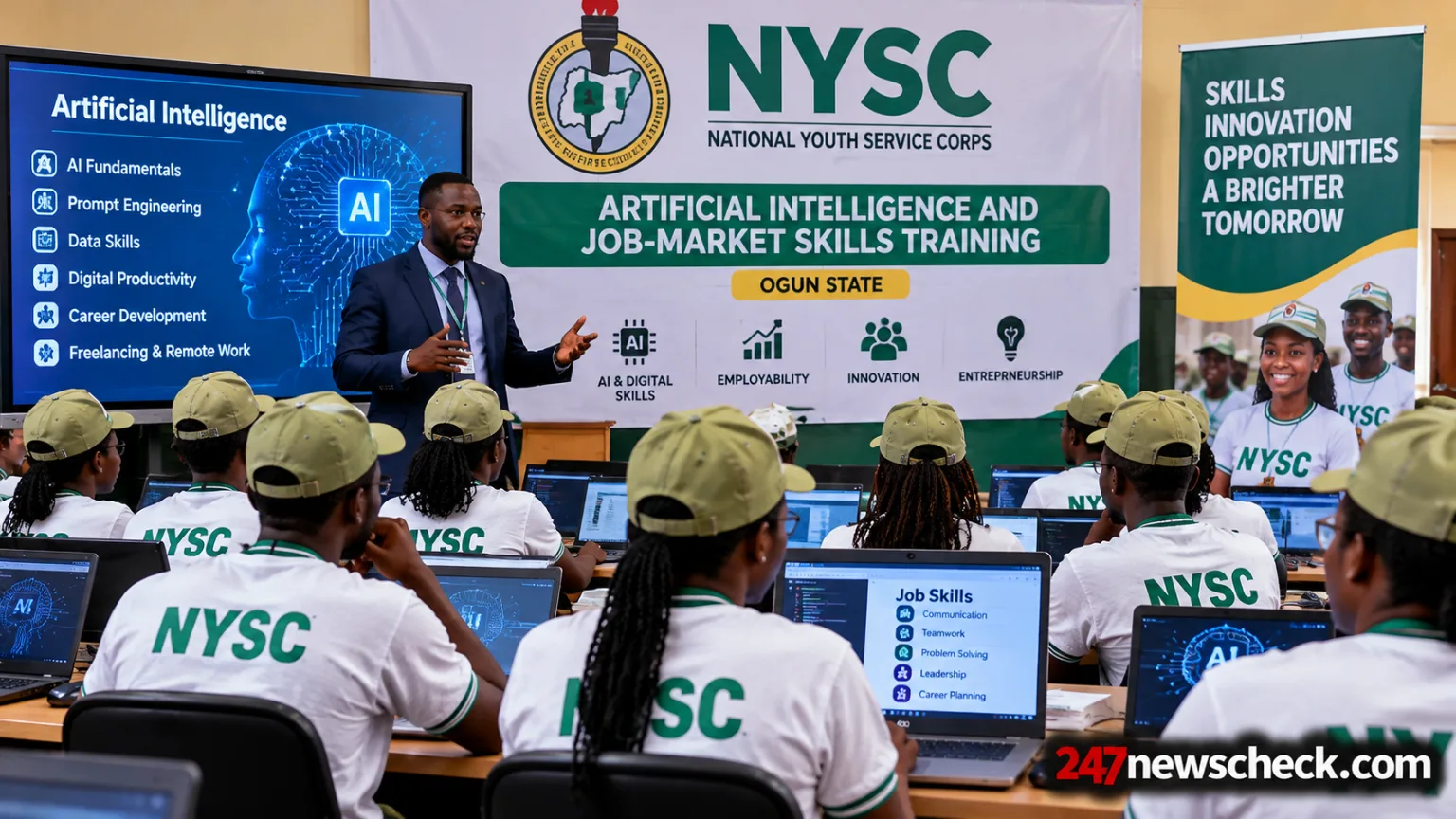
The National Youth Service Corps (NYSC) in Ogun State has organised a career development programme aimed at equipping corps members with practical knowledge of artificial intelligence (AI), workplace expectations and strategies for securing employment after their service year.
The programme, organised through the NYSC Obafemi Owode Local Government office in Mowe, brought together corps members, career resource persons and human resource professionals to discuss the changing demands of the labour market and the skills young graduates need to remain competitive.
The career conference, themed “Bridging the Gap Between Service and Success,” featured discussions on career development, the application of artificial intelligence in professional settings, drug-abuse prevention and practical approaches to finding employment.
Artificial intelligence and the changing workplace
A major focus of the programme was how corps members could use artificial intelligence to improve productivity and strengthen their readiness for employment.
Paul Ajadi, chief executive officer of Trinixbyte Solutions, spoke on leveraging AI during the transition into the labour market. He encouraged participants to use AI tools purposefully, with clear instructions and an understanding of the tasks they want to accomplish.
The presentation emphasised that access to AI tools alone does not guarantee professional advantage. The ability to apply the technology to real problems, assess its output critically and demonstrate practical competence remains important.
For young graduates entering an increasingly technology-driven economy, this distinction is significant. Employers may value applicants who can combine digital proficiency with sound judgement, communication, creativity and problem-solving.
Responsible use of AI also requires users to verify generated information, protect confidential data and retain responsibility for the accuracy and quality of their work.
Practical skills and employability
The conference also examined the qualities employers look for when recruiting graduates and the challenges applicants encounter during the job-search process.
Emmanuel Tarfa, co-founder and chief executive officer of KRYPTR, addressed the requirements corps members should consider as they prepare for life after national service. He highlighted mindset, competence and career strategy as important elements of professional development.
Tarfa also encouraged participants to strengthen their foundations in subjects such as mathematics, English and general studies, noting the relevance of these areas to communication, financial reasoning and an understanding of wider social issues.
During a panel discussion moderated by the president of the Sustainable Development Goals Community Development Service group, Tofunmi, human resource professionals shared advice on preparing applications and improving employment prospects.
Olajumoke Aladekomo, group head at MOMAS Group, identified poor application practices, character-related concerns and insufficient guidance as challenges that can affect job seekers. She encouraged corps members to seek mentors, remain resilient, ask questions and approach professional relationships with humility.
Emmanuel Adejare, human resources and administration lead at Planet Bottling Company Limited, advised applicants to study vacancy announcements carefully and tailor their CVs and applications to the positions they intend to pursue.
He also stressed the importance of developing relevant expertise rather than relying solely on academic qualifications or general applications that do not demonstrate a candidate’s suitability for a specific role.
Israel-Osho Fehintola, the Ogun State NYSC human resources officer, similarly encouraged corps members to practise consistently, develop skills aligned with their interests and build competence in their chosen fields.
Drug-abuse prevention included in the programme
Beyond career preparation, the conference addressed drug-abuse prevention and its potential consequences for individuals and communities.
Drug-abuse advocate Baiye Adebowale warned participants about the risks associated with substance misuse and called for sustained public education to discourage harmful behaviour.
He encouraged corps members to share prevention messages within their communities, presenting advocacy and peer education as ways to support wider awareness.
The inclusion of this discussion broadened the programme beyond employment advice, highlighting the importance of personal wellbeing and responsible decision-making as young people prepare for the next stage of their lives.
A wider challenge for young Nigerian graduates
The Ogun programme comes amid continuing discussions about how Nigeria can better prepare graduates for employment, entrepreneurship and a workplace increasingly influenced by digital technology.
Artificial intelligence is creating opportunities to improve productivity across several sectors, but access to the technology must be matched by practical training, critical thinking and the ability to apply knowledge in real-world situations.
For corps members, this means building demonstrable skills alongside academic credentials. Practical projects, relevant work experience, professional networks and carefully prepared applications can help candidates communicate their value to potential employers.
Career development initiatives can provide useful guidance, although participation in a conference alone cannot guarantee employment. Their longer-term impact depends on whether participants can apply what they learn and access further training and opportunities.
The NYSC’s wider Skill Acquisition and Entrepreneurship Development programme also provides a framework for encouraging self-reliance and enterprise among serving graduates. Continued emphasis on digital skills and practical competence could help corps members explore both paid employment and opportunities to establish their own businesses.
Preparing for life after service
The Ogun conference provided a platform for corps members to consider the expectations of employers, the practical uses of artificial intelligence and the importance of professional conduct in the workplace.
The central message was that successful transition from national service to employment requires preparation beyond obtaining a degree or completing the mandatory service year. Graduates must continue learning, develop relevant expertise and demonstrate their ability to solve problems.
For young Nigerians facing a competitive employment market, combining technological awareness with strong communication, integrity, adaptability and practical experience can provide a more solid foundation for career development.
247NewsCheck.com will continue to monitor developments in NYSC skills acquisition and youth employment initiatives as further verified information becomes available.