
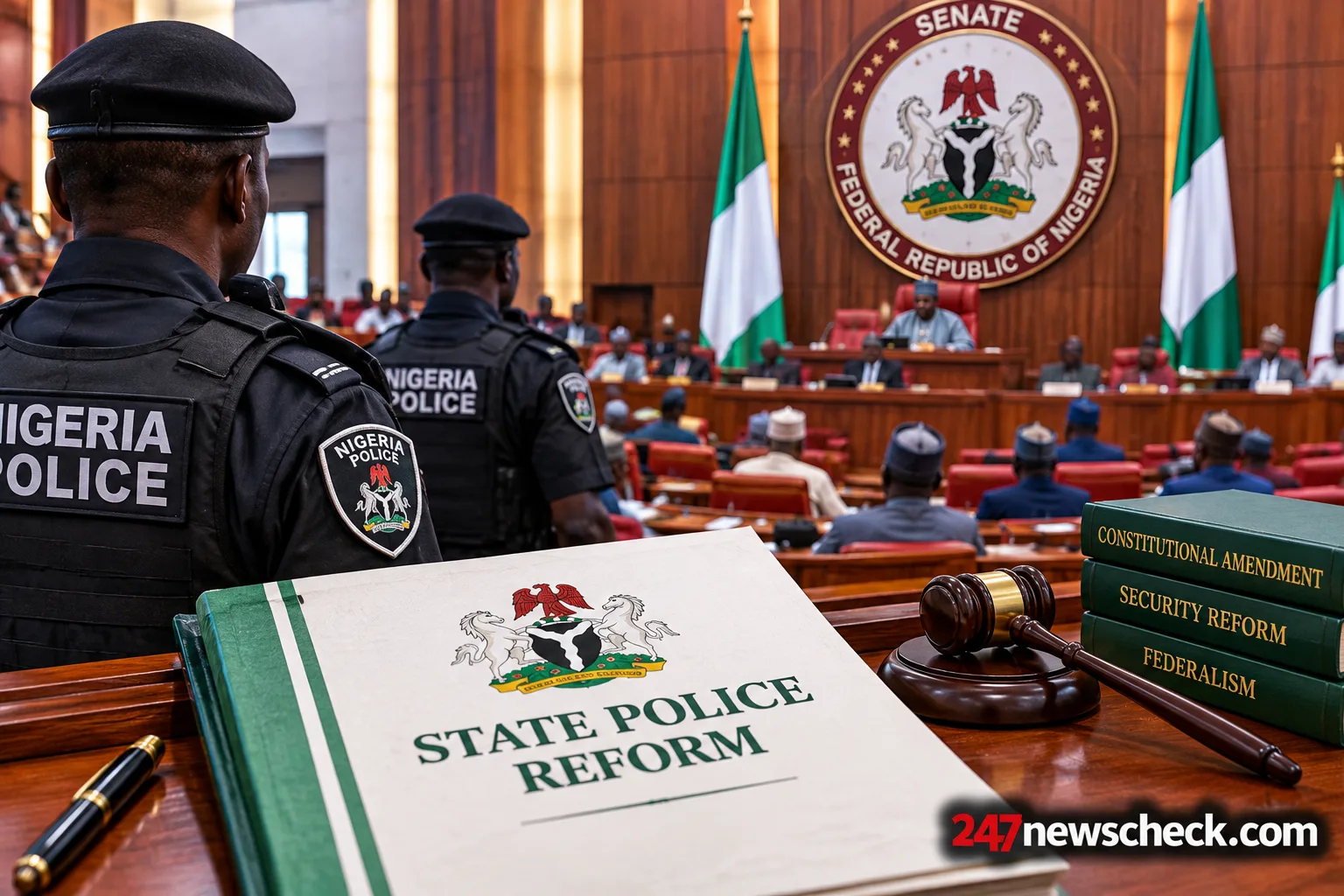
Nigeria’s Senate has reaffirmed its commitment to completing the legislative process for establishing state police before the end of 2026, as efforts to decentralise the country’s policing system advance amid persistent security challenges.
The assurance was given by Senator Yemi Adaramodu, Chairman of the Senate Committee on Media and Public Affairs, who said the National Assembly intended to conclude the process before its Christmas break.
The commitment follows renewed progress on the proposed constitutional amendment, including the approval of the measure by state legislatures required to meet the constitutional threshold. The Ondo State House of Assembly also passed the proposal on Monday, October 26, adding to the growing number of states backing the reform.
However, the Senate’s declaration is a commitment to complete the process, not confirmation that state police have already been established or are ready to begin operations.
Constitutional Process Moves Forward
The proposal to introduce state police is part of a wider effort to restructure Nigeria’s security framework by allowing state governments to maintain police services alongside a federal policing institution.
Both chambers of the National Assembly have approved constitutional amendment proposals relating to the establishment of state police. The relevant measure was subsequently transmitted to the 36 state Houses of Assembly on September 16, 2026, for consideration under the constitutional amendment procedure.
Section 9(2) of the 1999 Constitution requires a constitutional alteration to receive the support of at least two-thirds of the members of each chamber of the National Assembly and approval through resolutions passed by at least two-thirds of the state Houses of Assembly. For Nigeria’s 36 states, the state-level threshold is 24.
Recent reports indicate that the proposal has secured support from the required number of state legislatures, with Ondo among the latest states to approve it. The National Assembly must still receive and verify the relevant resolutions and complete the applicable legislative steps before the constitutional change can take effect.
The final process must also address the legislative requirements for giving effect to the proposed policing framework.
Senate Says Security Reform Remains a Priority
Adaramodu said the National Assembly was determined to meet its commitment to Nigerians and move the state police proposal forward without unnecessary delay.
He explained that the constitutional review process remained active and that the Senate would consider the relevant submissions once they were formally received.
The senator also stressed the importance of allowing stakeholders to contribute to the proposed framework because the creation of state police would have consequences for communities throughout the country.
The proposal has attracted considerable attention as federal and state authorities continue to confront security threats that include kidnapping, banditry, terrorism and other violent crimes.
Supporters argue that a more decentralised policing structure could improve intelligence gathering and allow law enforcement agencies to respond more quickly to threats in local communities.
How State Police Could Change Security Operations
Under the proposed arrangement, policing responsibilities would be distributed between federal and state institutions rather than remaining concentrated within a single national police structure.
Advocates of the reform believe state-based services could develop a closer understanding of local languages, social relationships, terrain and security concerns. They argue that such knowledge could strengthen cooperation with residents and improve the identification of emerging threats.
Senator Victor Umeh, who represents Anambra Central, has also supported decentralised policing, arguing that Nigeria’s size and varied local security conditions make a more distributed approach worth considering.
Nevertheless, the expected benefits will depend on how the system is designed, funded, supervised and implemented. Establishing additional police services alone would not automatically guarantee lower crime rates or faster responses.
Concerns Over Political Influence and Accountability
The proposed reform has also raised questions about the safeguards needed to prevent the misuse of police powers.
Critics have warned that state governors or other political authorities could attempt to use state police against political opponents, protesters or vulnerable communities. Other concerns include disparities in funding between states, recruitment standards, training, human rights protections and coordination between federal and state agencies.
A workable framework would therefore need clear rules defining the responsibilities of each level of policing, transparent recruitment procedures, independent oversight and effective mechanisms for investigating misconduct.
Adequate funding and professional training would also be essential if state police services are to operate effectively across states with different financial and institutional capacities.
These questions are likely to remain central as lawmakers and other stakeholders work towards a final legal framework.
Separate National Policing Bill Also Under Consideration
The state police constitutional amendment is progressing alongside work on a proposed National Policing Bill, 2026, and related legislative amendments.
A presidential working group chaired by Chief of Staff to the President Femi Gbajabiamila has been working on the national policing proposals. The group said draft legislation had been submitted to the Ministry of Justice for legislative drafting review and validation, with further consideration expected before presentation to President Bola Tinubu and possible transmission to the National Assembly.
The Senate has indicated that it will wait for formal communication before commenting on the executive’s proposed timetable.
The national policing bill and the constitutional amendment are related parts of the broader reform agenda, but their respective legislative requirements must not be treated as interchangeable.
What Happens Next?
The immediate task is to complete the required verification and constitutional procedures, resolve any outstanding legislative issues and establish the legal framework governing the proposed system.
Until those steps have been completed, Nigeria continues to operate under its existing policing arrangements. The Senate’s year-end pledge sets out its intended timetable, but the final outcome depends on the completion of the necessary legal and legislative processes.
For Nigerians affected by insecurity, the debate is ultimately about whether changes to the policing structure can translate into better protection, more effective investigations and greater public confidence in law enforcement.
247NewsCheck.com will continue to monitor the state police reform process and report further verified developments as lawmakers move towards the proposed year-end deadline.