
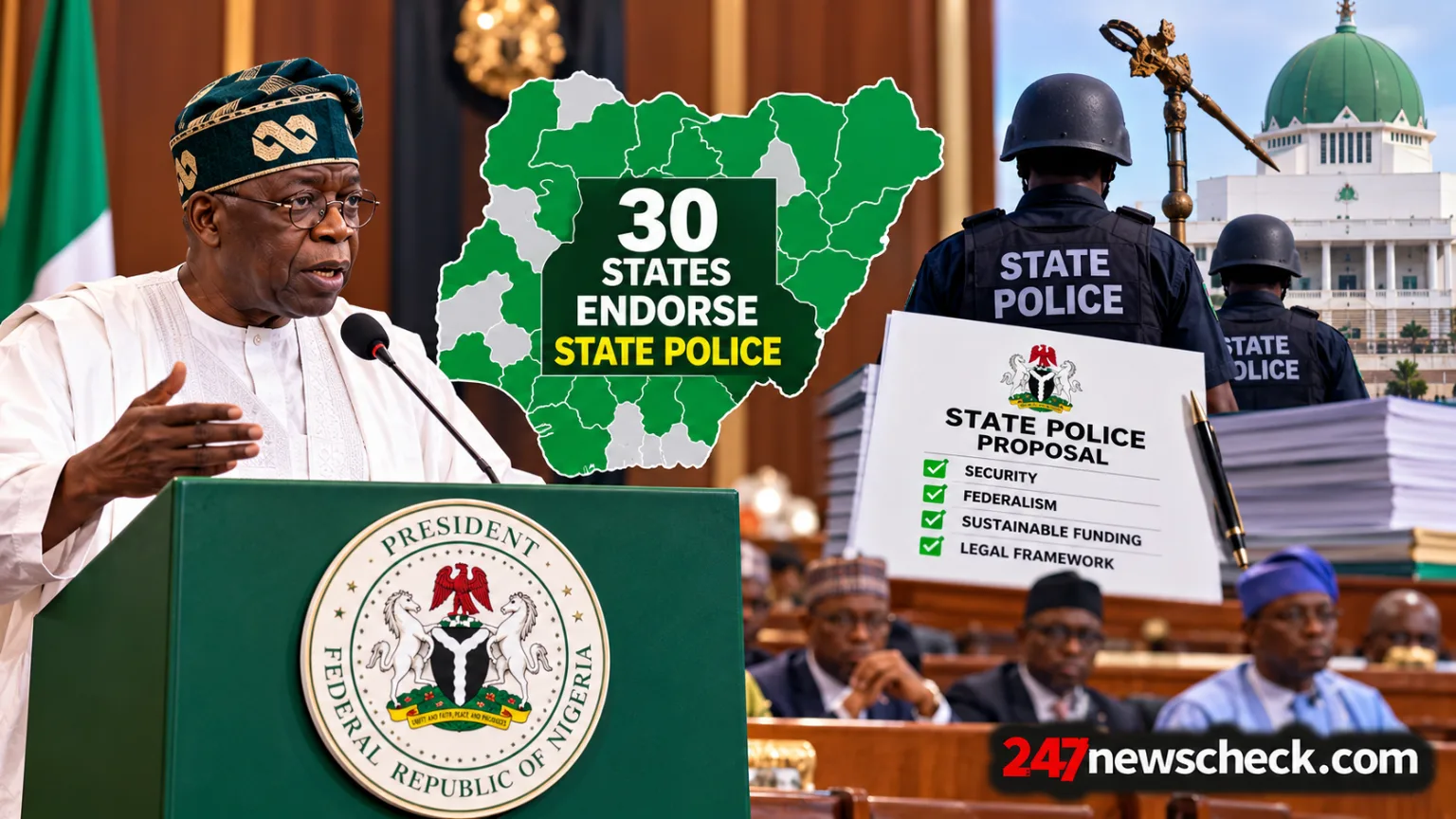
Support for the establishment of state police in Nigeria has continued to grow, with reports on Wednesday, October 28, indicating that 30 state legislatures have endorsed the proposed constitutional amendment. As the reform advances, the Presidency is urging business leaders and organised private-sector groups to help develop a sustainable funding model for the proposed policing structure.
The Chief of Staff to President Bola Tinubu and chairman of the Presidential Working Group on the National Policing Bill, Femi Gbajabiamila, said effective implementation would require states to demonstrate the financial capacity to maintain their own police services.
His position reflects a central question in Nigeria’s debate over decentralised policing: how states can assume greater responsibility for local security while ensuring that police personnel are adequately paid, trained, equipped and held accountable.
Presidency seeks sustainable funding framework
Speaking at the 32nd Nigerian Economic Summit in Abuja, Gbajabiamila called on the Nigerian Economic Summit Group, chambers of commerce and other business associations to contribute practical proposals for financing and implementing state police.
He said the proposed reform should not be limited to the initial purchase of vehicles, uniforms and equipment. States would also need reliable funding for salaries, professional training, operational expenses and institutional oversight.
The Presidency has warned that inadequate or unpredictable funding could undermine the independence of state police institutions and expose them to undue influence from private interests.
Gbajabiamila stressed that any private-sector participation must be transparent and accountable. Financial contributions, he said, must not give donors influence over investigations, police decisions or the treatment of individuals.
The proposed funding framework is therefore expected to consider the respective responsibilities of state governments, public institutions and any permitted private-sector partners, while protecting the independence of law-enforcement operations.
The Presidency has also indicated that states that are not financially or institutionally ready to establish their own police services would continue to rely on the federal policing structure.
State assemblies advance constitutional amendment
The growing number of state endorsements represents an important stage in the constitutional process required to establish state police.
The National Assembly previously passed the proposed constitutional amendment and transmitted it to state legislatures for consideration. Under Section 9(2) of Nigeria’s 1999 Constitution, a constitutional alteration of this nature requires approval by resolutions of at least two-thirds of the 36 state Houses of Assembly — a minimum of 24 states.
Recent reports have recorded additional endorsements, including decisions by legislatures in Lagos, Kano, Jigawa, Ebonyi and Kogi. Other reports have identified further approvals, although published tallies have not been entirely consistent.
The reported figure of 30 endorsements should therefore be read in the context of an ongoing legislative process, with the final tally requiring confirmation against official resolutions from the respective state assemblies.
Importantly, state-level endorsements do not mean that state police services have already become operational nationwide. The constitutional and legislative steps must be completed before the proposed system can be implemented under an effective legal framework.
National Policing Bill undergoes legal review
The Presidential Working Group has submitted the draft National Policing Bill, 2026, alongside 29 consequential amendment bills, to the Federal Ministry of Justice for legislative drafting review and validation.
According to the Presidency, the review is intended to ensure that the proposed bills comply with legislative drafting standards and do not conflict with existing laws.
The drafts are expected to return to the working group for final consideration before being presented to President Tinubu and subsequently transmitted to the National Assembly.
The proposed framework is designed to establish a dual policing structure, with federal and state police services operating within legally defined areas of responsibility.
Under the proposed arrangement, the federal police would retain responsibility for national and interstate security matters, while state police would provide a more localised response to security concerns within participating states.
The detailed legislation is expected to address recruitment, command structures, jurisdiction, professional standards, oversight and safeguards against abuse of police powers.
Security benefits and accountability concerns
Supporters of state police argue that officers operating closer to communities could develop stronger local intelligence networks, respond more quickly to distress calls and improve the investigation of crimes that require detailed knowledge of local conditions.
The proposal is being considered amid persistent security challenges, including kidnapping, banditry, terrorism, communal violence and attacks on rural communities.
However, decentralising police powers also raises concerns about political interference, uneven funding and the potential misuse of law-enforcement agencies against opponents or vulnerable groups.
A credible framework would need to establish independent complaint mechanisms, clear operational rules, professional training requirements and effective oversight at both state and federal levels.
It would also need to define how disputes between federal and state police services would be resolved and how national standards would be maintained across states with differing financial capacities.
These safeguards will be critical to determining whether the proposed system can improve public safety without weakening civil liberties or institutional accountability.
What happens next?
The next steps include completing the review of the National Policing Bill and its related amendments, confirming the state assemblies’ resolutions and advancing the remaining constitutional and legislative procedures.
The Presidency’s call for a sustainable funding plan indicates that financing is being treated as a core component of implementation rather than a secondary administrative issue.
For state governments, the challenge will be to demonstrate that they can maintain professional police services over the long term without diverting essential resources from other public responsibilities.
For residents, the effectiveness of any new system will ultimately be measured by whether it improves security, strengthens public trust, protects fundamental rights and makes law enforcement more responsive to local needs.
The growing political support marks progress for the state police proposal, but the final legal framework, funding arrangements and accountability mechanisms will determine how the reform translates into practice.
247NewsCheck.com will continue to monitor the constitutional process, funding proposals and legislative developments surrounding state police in Nigeria as further verified information becomes available.