
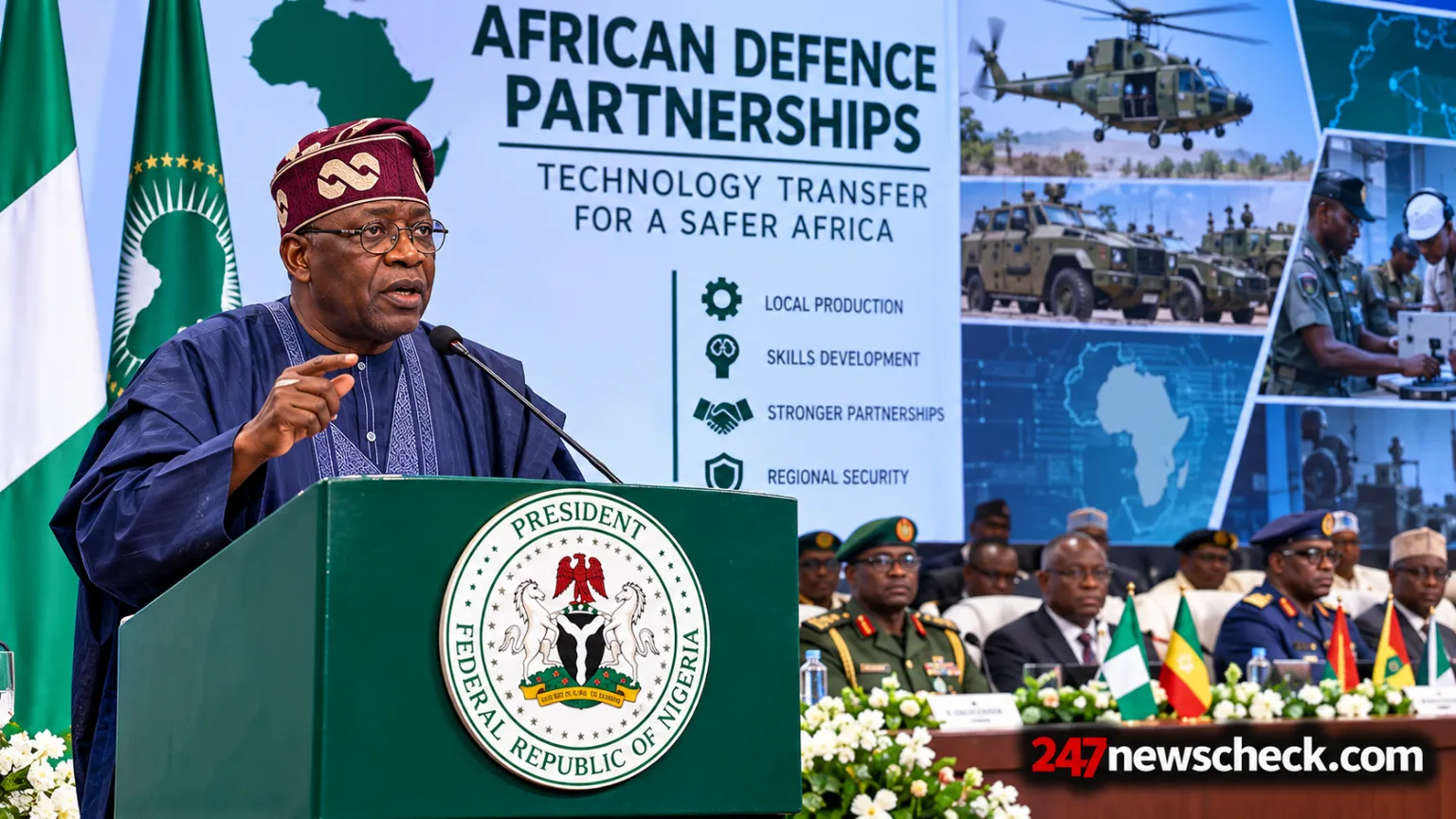
President Bola Ahmed Tinubu has called on African countries to make technology transfer, local industrial development and technical skills a central part of their defense partnerships, warning that the purchase of military equipment alone cannot provide lasting security for the continent.
Tinubu made the call in an address delivered by Senate President Godswill Akpabio at the opening ceremony of the Africa International Defense Exhibition (AFRIDEX) 2026 in Lagos on Monday, October 26.
The President argued that defence agreements should produce benefits that continue long after equipment has been delivered, including the capacity to maintain military systems, develop local expertise and strengthen institutions responsible for national security.
His message places greater emphasis on building African capabilities than on relying solely on foreign suppliers to provide equipment and technical support.
Technology Transfer as a Measure of Successful Partnerships
According to the President’s address, major defence acquisitions should create opportunities for African engineers to develop specialist expertise, local enterprises to expand and public institutions to become more capable of sustaining the systems they operate.
The approach would require international suppliers and African governments to consider training, technical knowledge-sharing, maintenance support and industrial participation when negotiating defense agreements.
For African countries that depend on imported military equipment, the ability to maintain and repair systems locally could reduce delays caused by dependence on overseas contractors and spare-parts supply chains.
However, the extent of those benefits would depend on the terms of individual agreements, the skills available locally and the resources committed to research, training and production. Technology transfer is not automatic simply because a country purchases equipment from a foreign manufacturer.
Tinubu’s position therefore highlights the need for measurable commitments that help African institutions retain technical knowledge and build sustainable industrial capacity.
Africa Faces Interconnected Security Threats
The President also warned that the continent’s security challenges increasingly cross national borders and extend beyond conventional military operations.
The threats identified in his address included terrorism, insurgency, banditry, piracy and cyber-related risks. He pointed to the Gulf of Guinea and the Sahel as areas where insecurity can affect neighbouring countries, trade routes and wider regional stability.
These challenges require cooperation between governments and security institutions, particularly where criminal networks operate across borders or exploit gaps in regional coordination.
Tinubu called for stronger partnerships that combine operational readiness with adequate training, reliable funding and institutional support.
He also emphasised that military personnel deployed to maintain peace must have the equipment, preparation and resources required to perform their duties effectively.
Maritime Security and the Gulf of Guinea
The President identified maritime cooperation as another priority, citing the importance of the Gulf of Guinea to African trade, energy security and economic activity.
The region’s shipping routes are important to the movement of goods and energy resources. Insecurity at sea can increase commercial risks, disrupt legitimate activity and create additional pressure on governments responsible for protecting maritime traffic.
Tinubu called for closer cooperation to safeguard these routes and prevent criminal networks from using the maritime environment as a base for illegal operations.
Effective cooperation in this area can involve information-sharing, coordinated patrols, training and compatible systems for monitoring maritime activity. The impact of such measures depends on sustained collaboration and the ability of participating countries to implement their commitments.
Emerging Technologies Require African Investment
Tinubu also urged African governments to invest in knowledge and institutions capable of understanding and responsibly using emerging technologies.
His address identified artificial intelligence, cybersecurity, space technologies and autonomous systems as areas that are changing the security environment.
These technologies can support surveillance, communications, intelligence analysis and other defense functions, but they also require specialist skills, secure infrastructure and appropriate oversight.
Developing African expertise in these fields could help countries adapt technology to their own security requirements rather than depend entirely on externally designed solutions.
The President further stressed the importance of creating opportunities for young Africans to contribute to innovation and technical development.
Such efforts would require long-term investment in education, research, engineering and cooperation between governments, universities and industry.
AFRIDEX 2026 Seeks Practical Outcomes
The Africa International Defence Exhibition provides a platform for governments, defense institutions and industry participants to examine equipment, exchange ideas and explore potential partnerships.
Tinubu urged participants to ensure that the exhibition produced practical results rather than remaining an event centred on displays and discussions.
For Nigeria and other African countries, the challenge will be to translate announcements and agreements into verifiable outcomes, including skills development, local industrial participation, improved maintenance capacity and stronger cooperation between security institutions.
The value of any agreement will ultimately depend on its implementation, the resources available and the extent to which it improves the ability of African countries to protect their populations.
Building African Defence Capacity
The President’s call reflects a broader debate about how African countries can strengthen security while reducing excessive dependence on external suppliers for essential defence capabilities.
Partnerships with international manufacturers and technology providers can offer access to equipment and expertise. Their long-term value, however, depends partly on whether they also help develop local skills, strengthen institutions and expand the ability to maintain and adapt systems.
For African governments, the challenge is to balance immediate security needs with investments that build lasting technical and industrial capacity.
247NewsCheck.com will continue to monitor developments from AFRIDEX 2026 and related African defense initiatives as further verified information becomes available.